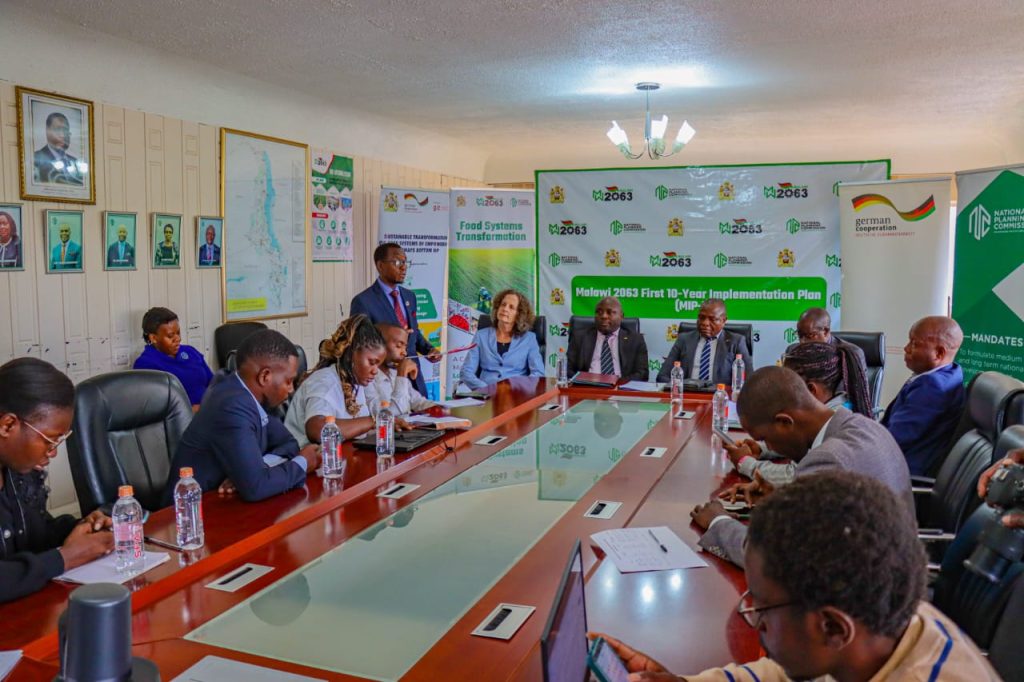
The Director General Mr. Fredrick Change (in red necktie) alongside NPC Commissioner Dr. Betty Chinyamunyamu (in green dress) and other NPC team members with Minister of Lands, Housing and Urban Development Honourable Jappie Mhango, MP after a courtesy meeting where the issue of Special Economic Zones was also discussed.
As we chart the course for Malawi to become an inclusively wealthy, self-reliant and industrialised upper-middle-income country by 2063, it is imperative to recognise the strategic role of Special Economic Zones (SEZs) in fulfilling that vision.
Under Malawi 2063, industrialisation is a central pillar — a transformation that requires more than ambition. It needs deliberate infrastructure, enabling policy, and conducive economic environments. The establishment of SEZs provides exactly that.
The legal framework for SEZs was enshrined in the Special Economic Zones Act (2024), giving the government the authority to declare, develop, regulate, and promote SEZs nationwide.
SEZs create zones with business-friendly regulations: tax and customs incentives, duty exemptions on raw materials and capital goods, simplified regulatory procedures and streamlined investment processes.
These incentives are designed to attract both domestic and foreign direct investment investors — a crucial step to shift Malawi’s economy from raw-material export dependency to value-added manufacturing and diversified industries.
One of the recurring limitations in Malawi’s development model has been heavy reliance on raw or semi-processed exports — vulnerable to global price fluctuations and yielding limited value to the local economy.
SEZs enable processing of raw materials within Malawi, adding value and shifting exports to finished or semi-finished goods rather than raw commodities. This supports the export diversification agenda under the national plan.
Through the integration of a well-structured SEZ network and supportive trade policy, Malawi can attract manufacturing, agro-processing, and export-oriented industries — thereby strengthening both backward and forward linkages in the economy.
Economic growth must translate into improved livelihoods for our people. SEZs offer a framework for that translation. Businesses that operate in SEZs tend to be labour-intensive — manufacturing, agro-processing, logistics — creating direct and indirect employment opportunities for Malawians.
As industries grow, there will be demand for skilled and semi-skilled labour, pushing workforce development, vocational training and capacity building — contributing to human capital development.
By stimulating industrial and economic activity beyond the major urban centres, SEZs can help narrow regional disparities and support balanced urbanisation, in line with the long-term goals of Malawi 2063.
SEZs also position Malawi to better leverage regional and continental trade agreements — maximising opportunities under frameworks like the African Continental Free Trade Area (AfCFTA) by scaling up production, improving export competitiveness, and integrating into regional value chains.
By facilitating investment flows and business formalisation, SEZs can contribute to stable and predictable economic growth — a prerequisite for long-term planning and the multi-decadal horizon of Malawi 2063.
SEZs Are Central to Achieving Malawi 2063 — But Success Requires Policy, Governance & Implementation
Let us seize this opportunity — for our generation and for generations to come.
Fredrick Changaya
Director General
National Planning Commission